
Increasing automation in industry and logistics is making mobile robotic systems a central component of modern intralogistics processes. Automated guided vehicles (AGVs) and autonomous mobile robots (AMRs) optimize internal material flows, reduce operating costs and increase process reliability. However, not every robot is suitable for every application. Choosing the right type of vehicle is crucial for efficiency and cost-effectiveness. In this article, we give you an overview of the most important types of mobile robots as well as their technical features and specific areas of application.
Vehicle types in mobile robotics
Mobile robots can basically be divided into several types, which differ in terms of their design, transport mechanics and application scenarios:
1. underride vehicles
Underride robots travel under special transport platforms, shelves or order picking trolleys and lift them slightly to move them autonomously. A typical field of application is order picking in warehouses. Systems such as the iw.hub from Idealworks or the L2 Lift from Safelog are typical representatives of this type. Their strengths lie in highly dynamic warehouse environments where flexibility and scalability are paramount. They are also particularly well suited to rapidly changing article structures and variable warehouse layouts.
2. towing vehicles / tractors
These vehicles move trailers or tugger trains through the warehouse or production hall. They are particularly suitable for sequenced production supply or transporting goods over longer distances with several load carriers. Manufacturers such as Jungheinrich and Linde offer high-performance systems for this purpose. Solutions of this type are particularly well established in the automotive industry, as they combine a high transport frequency with predictable routes.
3. lifting vehicles
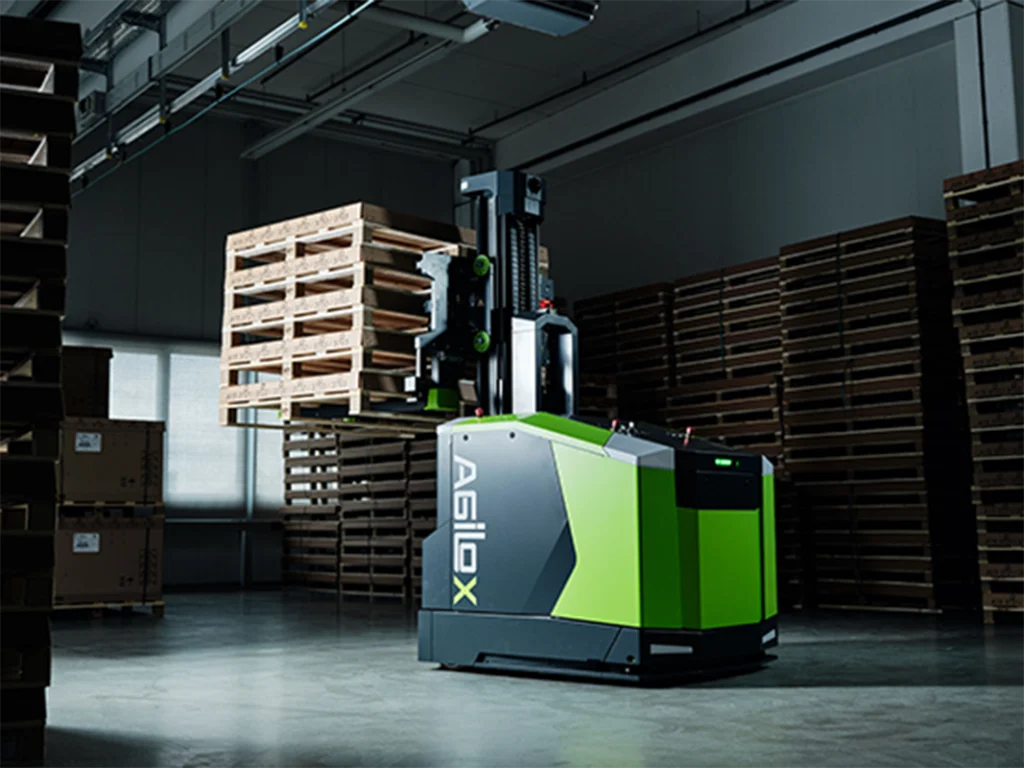
Similar to conventional forklift trucks, these mobile robots have their own lifting device and can therefore directly pick up and move pallet cages or pallets, for example. They are ideal for handling load carriers in incoming goods, for stock transfer or for production supply. Examples include the Agilox OCF or models from EK-Robotics.
4. specialized KLT vehicles
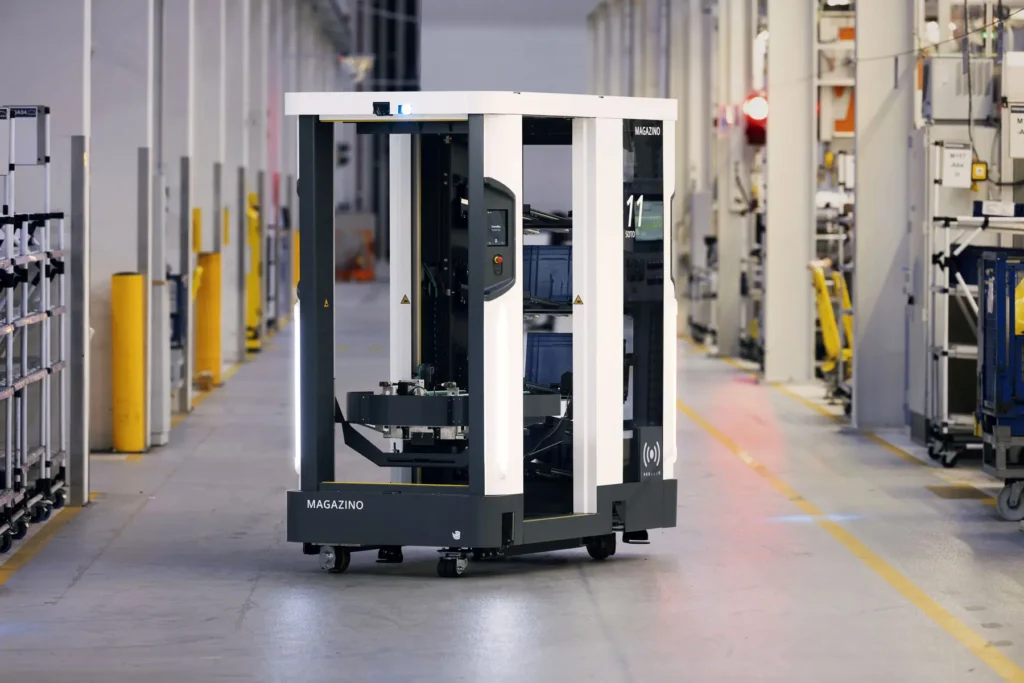
These types of mobile robots are specially designed for transporting small load carriers (SLCs). The SOTO model from Magazino and the ActiveShuttle from Bosch Rexroth are prominent examples of this. They are particularly suitable for automated production supply with small load carriers. This specialization enables automated, precise and error-free supply directly to the workplace.
Manufacturer overview and selected vehicle examples
A large number of established manufacturers offer various robot systems that differ in terms of capacity, navigation technology and expandability:
Omron
With the LD series (e.g. LD 250), Omron covers compact transport requirements, while the MD and HD series are designed for heavier loads of up to 1,500 kg. The vehicles work with SLAM/LiDAR navigation, are VDA5050-capable and are characterized by flexible expansion options and individual superstructures.
Magazino
With the SOTO, Magazino combines mobile robotics with AI-supported object recognition and gripping technology. It specializes in production supply with small load carriers and can independently remove, transport and store different containers. The vehicle has up to 24 spaces for buffering small load carriers.
Safelog
Safelog offers a broad portfolio of mobile robots, especially for internal material flow. The devices are fleet-based, cooperative and feature inductive and contour-based navigation. The consistent VDA5050 capability and modular design enable flexible adaptation to various applications such as production supply and disposal or assembly supply.
MetraLabs
The German manufacturer MetraLabs develops mobile robots with a focus on flexibility and collaborative behavior. In addition to applications in retail and research, models such as the XS1 are also used in intralogistics. The platforms are particularly suitable for individual adaptations and the integration of customer-specific modules.
Application scenarios and suitability for selected processes
The use of mobile robots should always be adapted to the specific intralogistics process. Some typical use cases are highlighted below:
- Order picking: Underride vehicles are particularly suitable for order picking according to the goods-to-person principle. They autonomously transport shelves, trolleys or platforms to the picking area. In conjunction with pick-by-light or voice systems, highly dynamic environments can be realized. In addition, such systems can be flexibly scaled and quickly adapted to seasonal fluctuations in demand, which makes them particularly interesting for the e-commerce environment.
- Production supply: For the sequenced supply of material to assembly lines, towing vehicles (e.g. the systems from Linde) designed for trailer transportation are particularly suitable. Magazino’s SOTO is the ideal solution for fine-tuned supply with small load carriers. Here, manual replenishment is replaced by fully automated picking and transport processes. Combinations with driverless forklifts or fixed conveyor lines are also possible, which further increases the consistency of the production supply.
- Incoming goods and stock transfer: Lifting vehicles and special narrow-aisle vehicles autonomously handle the storage and transfer of various load carriers. In conjunction with automated high-bay warehouses or conveyor technology, smooth material flows can be realized here. Especially in multi-shift operations, such robots ensure consistent performance, even with increasing transport volumes or at night.
- Outgoing goods: Compact transport robots such as the LD60/90 from Omron can remove end products from the production area and prepare them for dispatch. Time-critical shipping processes can also be flexibly controlled, for example for shipping on demand or in the express sector. In addition, mobile robots can also transport shipping aids or automate the wrapping or packing of pallets using rotating platforms.
- Empty container returns management: The management of empty KLTs or pallets is an application that is often underestimated. Depending on the load carrier, vehicles can be used specifically for automated returns. This relieves the burden on existing conveyor technology or manual systems for empties management.
Mobile robotic systems offer enormous advantages for intralogistics: they automate recurring transport processes, relieve employees and improve transparency and tracking of internal processes. The choice of the right vehicle is crucial. Whether towing vehicle, underride robot or small load carrier specialist – each system has different strengths and is particularly suitable for certain processes. This is precisely why the individual requirements should be analyzed precisely and the vehicles selected accordingly in order to achieve maximum efficiency in the process.
A structured comparison of vehicle types and their process advantages creates the basis for well-founded investment decisions in automated intralogistics. The combination of different vehicles in a mixed fleet can help to solve even complex logistical requirements in a flexible and scalable manner.