



Integrating Robotics into SAP
Warehouses are expected to operate faster and more accurately, yet many companies lack skilled workers. That is why more and more businesses are turning to mobile robots such as AMRs (Autonomous Mobile Robots).
There is a wide range of robots available from various manufacturers. The question is how they communicate with the warehouse management system. SAP’s solution to this is SAP Warehouse Robotics.
What is SAP Warehouse Robotics?
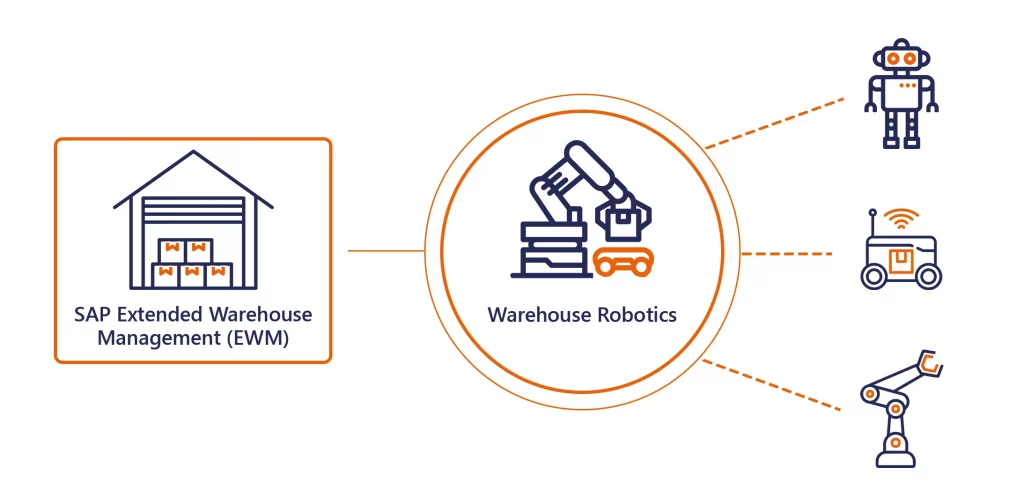
SAP Warehouse Robotics is an SAP solution designed to integrate robots with SAP EWM (Extended Warehouse Management). It runs as an add-on to SAP EWM on the SAP Business Technology Platform (BTP) and is available there as a subscription service.
According to SAP, Warehouse Robotics supports SAP EWM 9.5 as well as EWM in SAP S/4HANA starting with Release 2021, both as an embedded solution and as a decentralized solution. It covers a portion of the EWM processes, such as cross-docking, putaway, and order picking using robots.
How are robots connected?
SAP provides application programming interfaces (APIs) for warehouse robotics. A separate adapter is implemented for each robot manufacturer’s fleet management system. It translates the orders from SAP into the manufacturer’s language and reports the status back. Therefore, anyone using robots from multiple manufacturers will need multiple adapters.
What are the advantages of Warehouse Robotics?
- Less manual labor: Robots handle repetitive tasks, such as putting away or picking items.
- Fewer errors: Orders come directly from SAP EWM, and the status is updated automatically.
- Multiple manufacturers supported: Fleets from different providers can be integrated using adapters.
- Greater safety: Robots take over tasks such as moving heavy loads, which reduces the risk of injury.
Alternative: FlexGuide4 by Flexus
With FlexGuide4, Flexus controls the entire warehouse fleet directly in SAP: mobile robots, AGVs, forklifts, and tugger trains—all in a single system. For robots and AGVs, FlexGuide4 uses the open standard VDA 5050. Vehicles that support VDA 5050 can therefore be integrated regardless of the manufacturer, without having to build a separate interface for each manufacturer. Vehicles without VDA 5050 can also be integrated.
This way, robots and humans work with the same transport orders from SAP, rather than in separate systems.