



Industry:
Machinery and Plant Engineering, Metal Industry
Key Technologies:
SAP ERP, FlexGuide Transport Management System, Advantech-DLoG Forklift Terminals
Areas of Application:
Intralogistics, in-plant transport, warehouse and production logistics
Key Features:
Centralized transport control integrated directly into SAP, real-time tracking of all shipments, barcode-based material tracking, defined handoff zones, control center for process monitoring and efficiency analysis
Material Guidance System optimizes SAP intralogistics
SMS group GmbH, specialized in plant construction and mechanical engineering, has optimized internal logistics at the Hilchenbach site by means of a SAP®-integrated Material Guidance System, thereby minimizing the need of forklifts and the search effort.
Thinking on a grand scale. SMS group GmbH, which specializes in plant and machinery engineering, demonstrates what this means in an impressive way. The gigantic facilities at its historic Hilchenbach site cover an area of 120,000 square meters. The site would be large enough to host 34 soccer teams playing simultaneously. Instead, around 2,200 employees work here to design and manufacture steel components weighing up to 400 metric tons for metallurgical and rolling mill equipment, which is exported all over the world. The associated multi-stage material flow processes span several halls, production areas, and storage areas.
The SMS group is recognized worldwide for its forward-looking technologies and outstanding service in the field of machinery and plant engineering for the metal industry. The company leverages its 150 years of experience and digital expertise to drive continuous innovation even beyond its core business—and generates global revenue of approximately 4 billion euros. The company supports its customers throughout the entire life cycle of their plants, thereby enabling profitable, resource-efficient value chains—all the way through to recycling technologies. The company’s stated goal is to be a pioneer for a carbon-neutral and sustainable metals industry. As a global player with German roots, SMS group is positioned worldwide with more than 13,500 employees.
Two man-years of search time eliminated
One of the main requirements for the system they were looking for was the ability to integrate with the SAP® ERP system used by SMS group GmbH. “Avoiding interfaces within the data flow is one of our guiding principles,” emphasizes Marc-Oliver Greb. The graduate engineer works in the IT department at SMS group GmbH and, together with Steffen Rosenthal, was responsible for the project to implement the transport control system—TLS for short.
In addition to SAP®, this system had to integrate with the production planning and control software (FPS) developed in-house by SMS group GmbH to ensure true end-to-end continuity across all areas of production. “The number of providers offering such a solution was quite limited, so we very quickly got in touch with Flexus AG in Würzburg,” recalls Rosenthal.
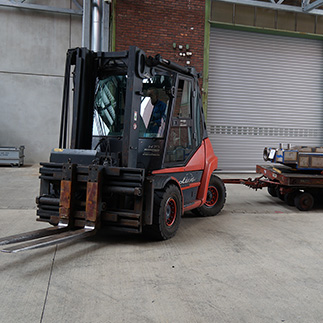
The materials required for individual orders are temporarily stored in various areas on the factory grounds. “For us, it was like a big black box, because there was no central control and information system for internal transport on the plant grounds,” explains Steffen Rosenthal, an industrial engineer who is responsible for technical project management at SMS group GmbH. Against this backdrop, there were repeated instances of lengthy search times in the past, which added up to as much as two man-years per year. For SMS group GmbH, this was reason enough to optimize the traceability of materials and the transparency of its own intralogistics. “We needed a centralized control system for the approximately 3,000 internal transports that take place each week,” Rosenthal sums it up. The intralogistics team at the Hilchenbach site has twelve forklifts and 39 trailers with payloads ranging from 15 to 120 metric tons at its disposal for moving goods between the incoming and outgoing goods areas.
“Thanks to the optimized transportation management, we were able to improve supply reliability and
Steffen Rosenthal
can now locate any material at any time, which means we have achieved the project’s main goal.”
Project Manager
SMS group GmbH
Order picking is integrated
Working together with the SAP® specialists at Flexus, SMS group GmbH was able to finalize the requirements specification as early as March 2014. The subsequent implementation took only three months, during which, in addition to the software, a total of 80 scanners, 12 Advantech DLoG forklift terminals (model DLT-V8310), and 35 PC stations were installed. The wireless handheld scanners are distributed among the forklifts, the PC stations, and various workstations in the high-bay warehouse. “After all, the solution encompasses not only the actual transport operations but also the contents of the small-parts containers being transported, which are picked in the high-bay warehouse,” explains IT expert Greb. The 35 PC stations are distributed throughout the entire warehouse and production area.
The computers and scanners, housed in robust cabinets, are used to request trailers as needed, to create transport orders and to “create” containers. Each transport order is automatically transmitted to one of the available vehicles and displayed with start and destination addresses on the Advantech-DLoG forklift terminal. If necessary, the driver is also informed of the location of a suitable trailer. Each unit towed is provided with a barcode label, which is scanned by the driver when the truck is docked. In this way, the use and utilization of the special trailers can also be tracked and analyzed without interruption.
Delivery at the place of value creation
At the point of loading, the driver additionally scans the goods taken over, which are now provided with a uniform accompanying label. Since 2014, every component and every container has had a precisely defined label that, in addition to a barcode, contains the most important data in plain text,” explains IT project manager Greb. The roughly 140 defined transfer zones, which are also equipped with a barcode, are also new. Each internal transport always leads to one of these zones, the number of which is constantly increasing. “At the end of the day, the material should be as close as possible to the location,” explains Rosenthal.
Following implementation, the testing phase began in July and was successfully completed after six weeks. Training for the 500 employees directly and indirectly affected had already begun in June, ensuring that nothing stood in the way of the on-time go-live on September 15. The training concept, developed jointly by Flexus and SMS group GmbH, was tailored to the various “role holders”—such as order pickers, forklift operators, shipping clerks, and the newly implemented control center—with learning content designed for each target group.
Forklift fleet reduced
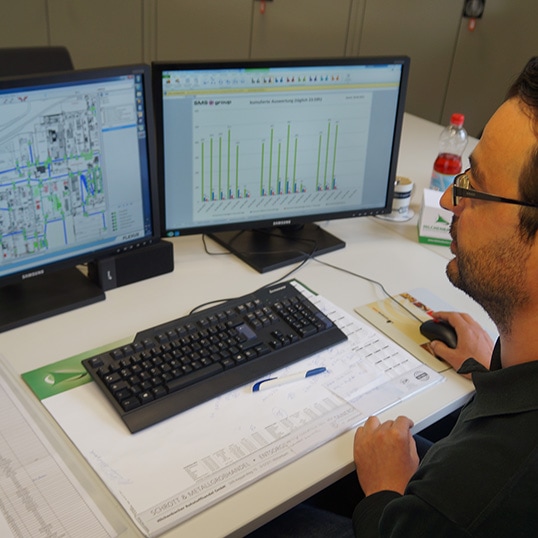
All processes in the control station are displayed in tabular form, graphically prepared and centrally monitored. In addition to manual intervention in the transport worklist, all individual parts can be located and traced using the material and WBS numbers.
“ We can now locate any material at any time and have thus achieved one of the project ’s main goals,” points out Rosenthal. In addition, targeted evaluations of the efficiency of the processes can now be created. This makes it possible to check whether the individual trailers and load carriers have been emptied within the required two-hour period. The first result of these calculations was not long in coming: after just a few weeks the forklift truck fleet could be reduced from twelve to 11 units.
Together with the minimized search times, this alone should make it possible to achieve the goal of reducing operating costs by 10 to 15 percent. In any case, the expected annual savings potential was achieved at the Hilchenbach site. It is to no surprise then that Flexus has already been commissioned with further major project steps. The Material Guidance System is also going to be introduced in the middle of 2016 at the location Mönchengladbach.
Do you have any questions or would you like some advice?
I am your contact person
Sascha Scherer
FlexGuide4 for worry-free intralogistics
phone: +49 931 466 211 100