



Industry:
Automotive Suppliers, Plastics Processing
Key Technologies:
SAP ECC 6.0, FlexMobile, mobile data collection, Poka Yoke checks
Areas of Application:
Inbound Receiving, Warehousing, Production, Order Picking
Key Features:
Global standardization of logistics processes, independent configuration via drag-and-drop, handling unit tracking with barcodes, paperless entries, and process reliability through Poka Yoke checks
Worldwide roll-out of the mobile SAP solutions
Transparent Tanks — For quality assurance and traceability of individual components in the production of vehicle tanks, automotive supplier Kautex Textron relies on Flexus’s FlexMobile mobile data collection solution.
Extreme temperatures and severe vibrations: When it really counts, a car’s fuel tank must withstand the most extreme conditions. Vehicle fuel tanks are critical to safety, and their production is therefore subject to strict regulations. Kautex Textron is one of the global market leaders in tank systems, which the Bonn-based company manufactures in 16 countries. In part to present a unified face to customers within its logistics operations, Kautex Textron had already decided in 2010 to standardize and streamline its logistics processes globally. All movements between goods receipt, production supply, production feedback, order picking, and goods issue were to be documented, verified, and visualized. At the same time, the company wanted to simplify communication during the individual process phases. To achieve this, the company sought an easy-to-use solution that communicates directly with the SAP enterprise resource planning system and tracks every single step of the components all the way to the fully assembled tank system. Additional poka-yoke checks were intended to make the process absolutely foolproof.
Kautex Textron is a global systems supplier to the automotive and packaging industries, headquartered in Bonn. Specializing in tank systems, the company employs 6,500 people in 16 countries and generated revenue of approximately 2.1 billion U.S. dollars in 2015. This makes Kautex Textron one of the top 100 automotive suppliers worldwide in terms of revenue. Founded in 1935, the company has been involved in blow molding and the production of hollow plastic parts since 1949. In 1964, Kautex introduced the first plastic fuel tank for passenger cars. Since 1996, the company has been part of the multi-industry conglomerate Textron Inc., which has a total of 34,000 employees and is headquartered in Rhode Island, USA.
“After the introduction of mobile solutions, we were able to track the distances traveled
Joerg Wojtun
as well as saving time and costs while increasing reliability.“
Head of Production Logistics
Kautex Textron GmbH & Co. KG
Bonn location
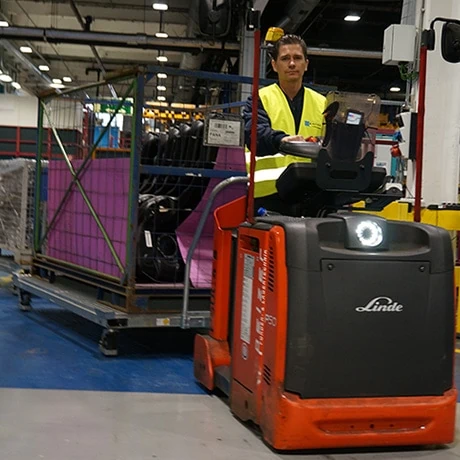
Configure via drag & drop
Following a thorough selection process, Kautex Textron decided to implement the SAP add-on FlexMobile ( SAP® ECC 6.0) from Flexus. “As an SAP partner, Flexus offers us direct integration of the application into our ERP system,” explains Christine Müller, who, together with Ria Classen, designs global logistics processes at Kautex Textron.
Another selling point was the more than 200 ready-to-use applications and templates already available, which customers can manage using a modular approach.
A wide range of applications is available for warehousing, internal transportation, production, and order picking. Mobile transactions are standardized. Users can create their own dialog boxes using a graphical layout designer via drag-and-drop and adapt them for use on various devices. “The solution is designed so that the global rollout can be carried out by our own IT staff independently of Flexus,” emphasizes Christine Müller. Flexus specialists only need to step in when individual changes are required within the logistics processes. “This is the case, for example, when customers approach us with new requirements and the processes need to be modified accordingly,” explains Christine Müller.
The Belgian production plant in Tessenderlo started in 2010. 16 other locations followed in Spain, Brazil, England, the Czech Republic, Germany and Romania. “We are now working there with standardized processes, which our globally active customers really appreciate,” says Christine Müller. More than 400 employees in the various storage and production areas now have access to the Flexus application. More than 130 mobile handhelds are used for this.
Every logistic unit traceable
The process of mobile data collection begins in the incoming goods warehouse. Every product that arrives there is provided with a barcode label. From this point on, the consignment unit is considered a so-called “handling unit”, HU for short, which can now be tracked individually throughout the logistics process. After the goods have been received, the HU is stored. To do this, the employee calls up the application intended for storage on their mobile device and scans the barcode. From here it goes either completely or in partial quantities to the respective site’s own production facility or – for example in the case of small parts – to the upstream supermarket. As soon as a new logistic unit is created, e.g. B. at the end of the production process, a new HU is created with its own label including barcodes. These HUs can also be processed using the Flexus application in further process steps such as picking.
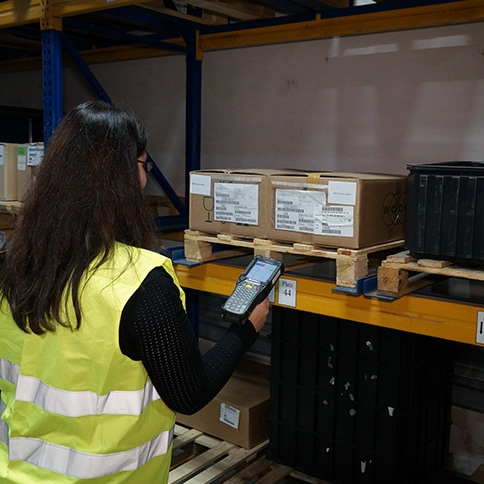
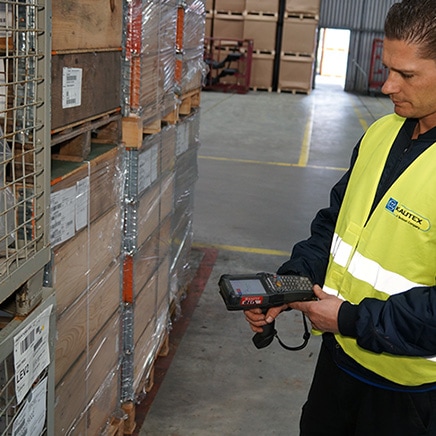
Reacting on site saves travel costs
Regardless of the process step, the HU data is synchronized with the ERP system via FlexMobile immediately after entry, allowing the current processing status to be queried in the SAP system. If there are any discrepancies or the entered data is incomplete, the process is immediately terminated and a warning message appears on the scanner. “The employee can now see right away on-site that something is missing and can react immediately with the help of FlexMobile ,” says Jörg Wojtun, who is responsible for logistics at the Bonn location. Without mobile data capture, employees used to have to go to a desktop PC in such cases. “After introducing FlexMobile , we were able to reduce travel distances, save time and money, and increase reliability at the same time,” confirms Jörg Wojtun.
Further savings potential
Since 2011, FlexMobile has proven itself at Kautex Textron, and the rollout is set to continue over the next few years. However, the project is far from over. After all, FlexMobile still offers further potential for savings and improvements, such as conducting inventory counts. Instead of “
” using paper count sheets, the annual full inventory will also be conducted using mobile terminals in the future. Christine Müller has already designed the corresponding process.
Background poka-yoke
The Japanese term “Poka Yoke” (“Prevent Errors”) refers to a principle consisting of several elements that encompasses technical measures for the immediate
detection and prevention of errors. Poka Yoke is based on the recognition that neither humans nor systems are capable of completely avoiding unintentional errors. Poka Yoke typically uses simple and effective systems to ensure that errors in the manufacturing process do not result in defects in the final product. An example of Poka Yoke in everyday life is a gas cap that is secured to the vehicle with a rubber band.
Your contact person

Jonas Heitz
SAP EWM Mobile Apps / SAP EWM
Phone: +49 931 466 211 100